Showing posts with label organ. Show all posts
Showing posts with label organ. Show all posts
19 November 2010
shooting stars
Although my short-term memory is abysmal, I'm starting to realize I have a long-term subconscious calendar memory that's uncannily precise. I've suddenly remembered to look up people's birthdays only to find that it was their birthday that day. And tonight I suddenly thought to look up when the Leonid meteor shower, an event I only seem to remember once a year or less, was going to happen, and found that it peaked yesterday. Alas, no staying up late for me until my organ recital at St. John's is finally squared away this Sunday.

22 December 2009
Eastman's glorious new organ in the NY Times
In a small way, I helped Munetaka Yokota voice this gorgeous instrument. Admittedly, I got a lot more out of the experience than he did. Nevertheless I feel very connected to it and am so pleased to see it garner national attention.
07 April 2009
O Haupt voll Blut und Wunden
Palm Sunday's service was the most beautiful I've played at St. Joseph. The congregation sang the final hymn, which Bach used for the St Matthew Passion, in harmony, and that hymn moves me more than any other. I don't often think of myself as a church organist, but if every service were like that, I wouldn't mind it at all.
There is an interesting carillon event coming up:
CARILLON 2009
A Special Program including Lou Reed’s “A Perfect Day”
The Riverside Church, 91 Claremont Avenue (at 120th Street), New York City
April 30, 2009 at 11:30am-12:30pm
The Riverside Church carillon is the largest in the world and made partly by Dutch craftsmen. On Koninginnedag, it will be called into service by the Dutch mastercarillonneur Sjoerd Tamminga, who has played “A Perfect Day” by Lou Reed for the past ten years in at the Maria Magdelena Church in Goes. This will be the finale to a series of carillon performances beginning in the Netherlands earlier in the day and ending at The Riverside Church at noon, where Lou Reed will be in attendance.
It reminds me of Doug Henderson's bell installation, Requiem for a Penny (2005). They both seem to imagine a worldwide synchronicity and sounding of bells for a "third listener" up in space.
There is an interesting carillon event coming up:
CARILLON 2009
A Special Program including Lou Reed’s “A Perfect Day”
The Riverside Church, 91 Claremont Avenue (at 120th Street), New York City
April 30, 2009 at 11:30am-12:30pm
The Riverside Church carillon is the largest in the world and made partly by Dutch craftsmen. On Koninginnedag, it will be called into service by the Dutch mastercarillonneur Sjoerd Tamminga, who has played “A Perfect Day” by Lou Reed for the past ten years in at the Maria Magdelena Church in Goes. This will be the finale to a series of carillon performances beginning in the Netherlands earlier in the day and ending at The Riverside Church at noon, where Lou Reed will be in attendance.
It reminds me of Doug Henderson's bell installation, Requiem for a Penny (2005). They both seem to imagine a worldwide synchronicity and sounding of bells for a "third listener" up in space.
24 September 2008
walking the tightrope
In the closing scne of the film Still Life, the protagonist and he alone notices a tightrope walker crossing from one ramshackle building to another in a town being "deconstructed" for the filling of the Three Gorges in China. I am starting to realize that I can understand my own path into music as a tightrope walk.
While at Eastman, I struggled to retain a sense of purpose and meaning as I made music without having the opportunity to contemplate what music meant or its place in society. Without reference to a context, music-making began to seem purposeless. As a musicology student, I now struggle with the meaning of music and its place in society on a daily basis. And yet I have not been satisfied over the past weeks because this struggle has left little time for performance. No longer an onerous chore, sitting down to learn new repertoire has become as mind-clearing and salutary as a long bike ride.
So musicology loses its meaning without performance and vice versa. And yet it's a tremendous challenge to excel at both. I'm giving myself ample time to learn the walk, but I have to find a balance before I stumble.
While at Eastman, I struggled to retain a sense of purpose and meaning as I made music without having the opportunity to contemplate what music meant or its place in society. Without reference to a context, music-making began to seem purposeless. As a musicology student, I now struggle with the meaning of music and its place in society on a daily basis. And yet I have not been satisfied over the past weeks because this struggle has left little time for performance. No longer an onerous chore, sitting down to learn new repertoire has become as mind-clearing and salutary as a long bike ride.
So musicology loses its meaning without performance and vice versa. And yet it's a tremendous challenge to excel at both. I'm giving myself ample time to learn the walk, but I have to find a balance before I stumble.
25 May 2008
AGO Fight Song
We're AGO, we're AGO
We guard Cecilian flanks;
Through music's fray
We gravely go forth
Undivided, united
And armed with pipes in ranks
We know with Diapasons Great and Swell
And with just two feet and hands
Our sound
Can astound
And confound
All philharmonic bands
With registration, Gen'rals set,
Our armed Aeolian squad
With loud Cornet, Posaune, Trompette
At the ready, all steady and mounted en chamade,
To shake the walls we'll couple our Bombarde
And with Tuba daunt the foe.
We say
It's OK Hip Hoo-ray
For we're the AGO.
We guard Cecilian flanks;
Through music's fray
We gravely go forth
Undivided, united
And armed with pipes in ranks
We know with Diapasons Great and Swell
And with just two feet and hands
Our sound
Can astound
And confound
All philharmonic bands
With registration, Gen'rals set,
Our armed Aeolian squad
With loud Cornet, Posaune, Trompette
At the ready, all steady and mounted en chamade,
To shake the walls we'll couple our Bombarde
And with Tuba daunt the foe.
We say
It's OK Hip Hoo-ray
For we're the AGO.
26 April 2008
AGO carillon concerts
Dave Johnson is playing two carillon concerts at the AGO national "Twin Cities" convention! Awesome!
30 March 2008
carillon as installation art
"Does it work as a stand-alone piece?" I asked about the carillon piece meant for the Yale School of Drama's winter production, a piece axed by the administration as the carillon couldn't sound during finals week. "Well, Miss Tiffany Ng," Dr. S said, turning intently to me. And so the idea of a carillon installation has taken seed.
I am--joyously--getting up to my ears in new music for carillon, both acoustic and electroacoustic. But what about the overwhelming physical presence of the carillon, the visual, the visceral aspect of the bells and the belfry? (Never mind that the UR's carillon is basically disembodied.) How many composers and artists have taken advantage of that? Jeffery Bossin has done cool projects in Berlin, but what of interest has happened in America?
Eastman had better figure out what's going on with that Hanson Commissioning Fund, because I have big plans for it. I envision an installation that isn't so site-specific that it can't be recreated in other cities, or even with a traveling carillon in a large art gallery.
Speaking of which, new organ music mission accomplished this week. Twofold.
I am--joyously--getting up to my ears in new music for carillon, both acoustic and electroacoustic. But what about the overwhelming physical presence of the carillon, the visual, the visceral aspect of the bells and the belfry? (Never mind that the UR's carillon is basically disembodied.) How many composers and artists have taken advantage of that? Jeffery Bossin has done cool projects in Berlin, but what of interest has happened in America?
Eastman had better figure out what's going on with that Hanson Commissioning Fund, because I have big plans for it. I envision an installation that isn't so site-specific that it can't be recreated in other cities, or even with a traveling carillon in a large art gallery.
Speaking of which, new organ music mission accomplished this week. Twofold.
12 February 2008
clavichordium
It would appear that I've passed my clavichord jury to good approval--just about the last outcome I was expecting. I must admit that every time I'm forced to practice it seriously, I develop a fondness for the instrument. After a break from bad habits and confusion, my technique has certainly improved this year. With the instrument's sensitivity as more friend than foe (though it will probably always retain the characters of both), I'm finding the clavichord rather satisfying to play. Perhaps one day I'll have one for myself... it will be cheaper than an organ after all.
01 November 2007
"What? What? Am I seeing things?"
In my short life so far, those are some of the few words I've uttered loudly and unabashedly to myself and myself alone. I am flipping through Kerala's The Organ as a Mirror of its Time on a whim, idly wondering if an article in it might be obliquely related to my 19th-century carillon/organ research into Bollée, Cavaillé-Coll, etc. And what should my eyes fall on when I flip to Owen's "Technology and the organ in the 19th century," but
"...in Birmingham, [Hill's] all-mechanical action was so stiff and heavy that... Cavaillé-Coll compared the Birmingham action to that of a carillon."
I feel as if I'm just awakening from a shock and a fainting spell. Was this M. Aristide's conjecture or did he try a carillon somewhere? Bollée's at the Exposition or later in Perpignan? Better yet, elsewhere??? Perhaps I ought to take Erica's advice and write to Douglass. Perhaps I also need to map out CC's travels to figure out where he might have encountered carillons. There is more to this story than meets the eye.
And to think that this piece of the puzzle came to me from Hans Davidsson.
In my short life so far, those are some of the few words I've uttered loudly and unabashedly to myself and myself alone. I am flipping through Kerala's The Organ as a Mirror of its Time on a whim, idly wondering if an article in it might be obliquely related to my 19th-century carillon/organ research into Bollée, Cavaillé-Coll, etc. And what should my eyes fall on when I flip to Owen's "Technology and the organ in the 19th century," but
"...in Birmingham, [Hill's] all-mechanical action was so stiff and heavy that... Cavaillé-Coll compared the Birmingham action to that of a carillon."
I feel as if I'm just awakening from a shock and a fainting spell. Was this M. Aristide's conjecture or did he try a carillon somewhere? Bollée's at the Exposition or later in Perpignan? Better yet, elsewhere??? Perhaps I ought to take Erica's advice and write to Douglass. Perhaps I also need to map out CC's travels to figure out where he might have encountered carillons. There is more to this story than meets the eye.
And to think that this piece of the puzzle came to me from Hans Davidsson.
18 October 2007
Carillon and Organ: Uncovering a Missing Link
Here they are, my submitted Fulbright essays. All this work had better get me somewhere (literally) this time:
In 2006, the sun flooded an overcast February day as I began to ring the bells of the University of Rochester’s carillon. Students emerging from classes gathered before the belfry, asking questions. Is there a musical instrument in that usually silent tower? Can students learn to play?
I enrolled at the Eastman School of Music filled with the hope that as an organ student, I could also realize the potential of this magnificent forgotten instrument, comprising four octaves of bells in a tower played without electric assistance from a keyboard and pedalboard. Over the past year, I have drawn the interest of community groups and the university president alike to this Dutch-crafted treasure, achieving my most urgent public awareness and repair goals and initiating long-term development. The Eastman Organ Department, Eastman Computer Music Center, College Music Department, and a new carillon scholar are cooperating with me in this rejuvenation. I will ensure that the movement becomes self-sustained, because my next degree will prepare me to spearhead the development of a university carillon program from which I can, as an influential teacher, set in motion the revitalization of instruments well beyond Rochester.
My twofold goal combines the organ and carillon in an unprecedented program of study. The American carillon is in jeopardy because instruments outnumber competent players. Historic instruments have fallen silent, their potential to enrich public life forgotten. My answer to this crisis is to attract new talent as a teacher and to call on organists to become stewards and even players of carillons in their churches. I am already bridging the historically related instruments through my research and professional activities. Through university teaching and research, I will establish the carillon as an academic and artistic discipline and create the first environment in which an international panoply of styles can flourish. In the Netherlands, Utrecht University is expanding the music program of its English-language international honors college, the Roosevelt Academy (RA), into the graduate Roosevelt School of Music (RSM). This offers the first chance in history for a carillonist to help realize both goals in preparation to implement them in the US.
At RSM I will study performance on both instruments and, in preparation for a teaching career, develop methods of integrating the studies with experts in both fields. My thesis for the one-year Master of Arts in Musicology & Applied Performance (Carillon) degree will build on the two years of research I will have already pursued through the interdisciplinary sequence “The History of the Organ, its Literature, and Social Context” at Eastman. I will graduate prepared to integrate the study of these instruments in doctoral studies as very few musicians or scholars can.
I am expanding the campanological collection of Eastman’s library and teaching carillon students. But in my research on parallels in the developments of the Dutch organ and carillon in terms of construction, repertoire, and social function, I have found American libraries lacking. One of my papers proposed that while organs and bells developed separately for secular use, the invention of the carillon in the early 16th century allowed their evolutions to partially converge, and during the Reformation to temporarily exchange societal roles. Furthermore, I have found that the carillon underwent equivalent developments to the organ but at intriguingly later dates. My most recent paper analyzed the growing carillon repertoire derived from organ and harpsichord music in the 17th and 18th centuries and causality in the eventual decline of carillon performance and of both carillon and organ building. At RSM, I will be able to make detailed studies of source materials such as early keyboards and carillon, organ, and harpsichord manuscripts, read the large body of carillon research centered in the Low Countries, and consult leading scholars. My thesis will probe connections beginning with the early development of the instruments, and those findings can help bring the carillon back to the forefront of organ studies.
The broader future of the carillon in America is of great concern to me. Much of our carillon heritage is in disrepair or forgotten, in part because the carillon and organ worlds have drifted apart. Carillons were first built and played largely by organ builders and organists in the Low Countries, but today organists are often given authority over carillons about which they know little. By reestablishing the carillon’s importance to organ history, I am providing knowledge that organists need to protect neglected carillons from destructive modification.
Upon attending a 2005 performance by Geert D’hollander, who would become my teacher at the Royal Carillon School, I understood for the first time what it meant not just to play the carillon, but to make music with it. His artistry rivals that of touring concert pianists. The lack of such performers in the US prevents the carillon from being taken seriously. His instruction can help me achieve a professional performance level in order to attract outstanding musicians to my program. I hope to teach a new generation to win the instrument the place it deserves in our country’s public life, revive silent carillons, and see that carillons rather than synthesized chimes are built. It is organists who can best ensure the conservation of this heritage from the Low Countries; they often fail because they are unaware of the carillon’s expressive capabilities, though it offers the largest dynamic range of any acoustic instrument. An electric chime machine and a carillon seem equally musically viable to the uninitiated—and that misconception is at the root of the disasters I want to avert. The Eastman organ department has set a precedent with its model of integrated teaching of the organ, clavichord, and pedal piano, and my curricular investigations at RSM will help me develop a similar program. Through artistry in performing, public outreach, and education, I hope to recover the carillon and to enlist defenders nationwide to recoup the tradition. I am already forging connections with organ builders and restorers. During the 2007 Eastman Rochester Organ Initiative Festival, I gave a recital and talk on the need for carillon preservation. Many of America’s prominent organ builders and scholars embraced my message and its immediate relevance to organists, urging me to bring it to yet wider audiences.
The future of the carillon also depends on international collaboration. I joined a diverse class at the RA’s past two summer carillon courses, first as a student and then as an Eastman Arts Leadership Program intern. In addition to teaching lessons, I helped adult students lay foundations for cross-cultural partnerships in education and carillon restoration between three continents. D’hollander, widely considered one of the world’s leading carillon composers and performers, acts not only as RSM carillon professor, but also as a guest teacher and liaison between national schools. I intend to continue his mission, exploring each style in my teaching to foster well-rounded musicians able to initiate change by bringing disparate communities together.
I want to participate directly in the founding year of RSM’s carillon and organ program, working with director Albert Clement, my trusted advisor and former internship supervisor, to give direction to the program and gain insight not only into educational planning, but also into the administrative challenges of establishing a graduate school. By weaving together carillon and organ training towards a doctorate, I can best meet the challenges of my career—developing an teaching practice that explores the carillon and organ as related musical instruments and that establishes a new level of carillon artistry and scholarship in the US. I want to create an interdisciplinary environment for research into historical relationships and their consequences for construction and performance practice today. The chance to prepare through direct involvement for such a goal will certainly not come again before I begin my task. Thus, there is no better time or place for me than the Roosevelt School of Music from September 2008 to May 2009.
In 2006, the sun flooded an overcast February day as I began to ring the bells of the University of Rochester’s carillon. Students emerging from classes gathered before the belfry, asking questions. Is there a musical instrument in that usually silent tower? Can students learn to play?
I enrolled at the Eastman School of Music filled with the hope that as an organ student, I could also realize the potential of this magnificent forgotten instrument, comprising four octaves of bells in a tower played without electric assistance from a keyboard and pedalboard. Over the past year, I have drawn the interest of community groups and the university president alike to this Dutch-crafted treasure, achieving my most urgent public awareness and repair goals and initiating long-term development. The Eastman Organ Department, Eastman Computer Music Center, College Music Department, and a new carillon scholar are cooperating with me in this rejuvenation. I will ensure that the movement becomes self-sustained, because my next degree will prepare me to spearhead the development of a university carillon program from which I can, as an influential teacher, set in motion the revitalization of instruments well beyond Rochester.
My twofold goal combines the organ and carillon in an unprecedented program of study. The American carillon is in jeopardy because instruments outnumber competent players. Historic instruments have fallen silent, their potential to enrich public life forgotten. My answer to this crisis is to attract new talent as a teacher and to call on organists to become stewards and even players of carillons in their churches. I am already bridging the historically related instruments through my research and professional activities. Through university teaching and research, I will establish the carillon as an academic and artistic discipline and create the first environment in which an international panoply of styles can flourish. In the Netherlands, Utrecht University is expanding the music program of its English-language international honors college, the Roosevelt Academy (RA), into the graduate Roosevelt School of Music (RSM). This offers the first chance in history for a carillonist to help realize both goals in preparation to implement them in the US.
At RSM I will study performance on both instruments and, in preparation for a teaching career, develop methods of integrating the studies with experts in both fields. My thesis for the one-year Master of Arts in Musicology & Applied Performance (Carillon) degree will build on the two years of research I will have already pursued through the interdisciplinary sequence “The History of the Organ, its Literature, and Social Context” at Eastman. I will graduate prepared to integrate the study of these instruments in doctoral studies as very few musicians or scholars can.
I am expanding the campanological collection of Eastman’s library and teaching carillon students. But in my research on parallels in the developments of the Dutch organ and carillon in terms of construction, repertoire, and social function, I have found American libraries lacking. One of my papers proposed that while organs and bells developed separately for secular use, the invention of the carillon in the early 16th century allowed their evolutions to partially converge, and during the Reformation to temporarily exchange societal roles. Furthermore, I have found that the carillon underwent equivalent developments to the organ but at intriguingly later dates. My most recent paper analyzed the growing carillon repertoire derived from organ and harpsichord music in the 17th and 18th centuries and causality in the eventual decline of carillon performance and of both carillon and organ building. At RSM, I will be able to make detailed studies of source materials such as early keyboards and carillon, organ, and harpsichord manuscripts, read the large body of carillon research centered in the Low Countries, and consult leading scholars. My thesis will probe connections beginning with the early development of the instruments, and those findings can help bring the carillon back to the forefront of organ studies.
The broader future of the carillon in America is of great concern to me. Much of our carillon heritage is in disrepair or forgotten, in part because the carillon and organ worlds have drifted apart. Carillons were first built and played largely by organ builders and organists in the Low Countries, but today organists are often given authority over carillons about which they know little. By reestablishing the carillon’s importance to organ history, I am providing knowledge that organists need to protect neglected carillons from destructive modification.
Upon attending a 2005 performance by Geert D’hollander, who would become my teacher at the Royal Carillon School, I understood for the first time what it meant not just to play the carillon, but to make music with it. His artistry rivals that of touring concert pianists. The lack of such performers in the US prevents the carillon from being taken seriously. His instruction can help me achieve a professional performance level in order to attract outstanding musicians to my program. I hope to teach a new generation to win the instrument the place it deserves in our country’s public life, revive silent carillons, and see that carillons rather than synthesized chimes are built. It is organists who can best ensure the conservation of this heritage from the Low Countries; they often fail because they are unaware of the carillon’s expressive capabilities, though it offers the largest dynamic range of any acoustic instrument. An electric chime machine and a carillon seem equally musically viable to the uninitiated—and that misconception is at the root of the disasters I want to avert. The Eastman organ department has set a precedent with its model of integrated teaching of the organ, clavichord, and pedal piano, and my curricular investigations at RSM will help me develop a similar program. Through artistry in performing, public outreach, and education, I hope to recover the carillon and to enlist defenders nationwide to recoup the tradition. I am already forging connections with organ builders and restorers. During the 2007 Eastman Rochester Organ Initiative Festival, I gave a recital and talk on the need for carillon preservation. Many of America’s prominent organ builders and scholars embraced my message and its immediate relevance to organists, urging me to bring it to yet wider audiences.
The future of the carillon also depends on international collaboration. I joined a diverse class at the RA’s past two summer carillon courses, first as a student and then as an Eastman Arts Leadership Program intern. In addition to teaching lessons, I helped adult students lay foundations for cross-cultural partnerships in education and carillon restoration between three continents. D’hollander, widely considered one of the world’s leading carillon composers and performers, acts not only as RSM carillon professor, but also as a guest teacher and liaison between national schools. I intend to continue his mission, exploring each style in my teaching to foster well-rounded musicians able to initiate change by bringing disparate communities together.
I want to participate directly in the founding year of RSM’s carillon and organ program, working with director Albert Clement, my trusted advisor and former internship supervisor, to give direction to the program and gain insight not only into educational planning, but also into the administrative challenges of establishing a graduate school. By weaving together carillon and organ training towards a doctorate, I can best meet the challenges of my career—developing an teaching practice that explores the carillon and organ as related musical instruments and that establishes a new level of carillon artistry and scholarship in the US. I want to create an interdisciplinary environment for research into historical relationships and their consequences for construction and performance practice today. The chance to prepare through direct involvement for such a goal will certainly not come again before I begin my task. Thus, there is no better time or place for me than the Roosevelt School of Music from September 2008 to May 2009.
Personal statement
This is my "CV" or personal statement, intended to give background about me as an individual. I was unhappy with it nearly until I submitted it, but after drastic revision it's doing okay:
During my first months in Belgium as a Fellow of the Belgian American Educational Foundation in 2005, I discovered a principle governing my new life: All that can go wrong may well go wrong on the same day. But through a lens of frustrated tears, I focused on a new under-standing of life: Even the worst situations may conceal reasons to be thankful. My adjustment woes were proof that I was realizing my dream of studying the carillon. I have since met chal-lenges and setbacks with gratitude, approaching them as the complement of real progress.
That I came to music at a late age and found my calling in it even later has positively shaped my goals. I grew up more used to distant gunfire in my low-income neighborhood than the strains of art music. The piano I wanted since age four was beyond reach until my family’s hard work bought one when I was ten. Eventually I made it to Yale, where the premise that stu-dents can dive into new fields and take leadership roles brought me to two new instruments, the carillon and organ. Spearheading the carillon’s restoration and the 2006 Congress of the Guild of Carillonneurs in North America, I found power to effect change through music leadership.
Yale broadened my development in other ways. Joseph Soares’s powerful sociology course, “Public Culture in America,” gave me a new perspective on my past and a sense of my responsibility to promote equality of educational opportunity. My Yale and conservatory educa-tions have placed within my reach a wealth of possibilities from which my childhood peers re-main isolated. The love of teaching I developed over three years of teaching carillon to Yale classmates and over a summer of teaching underprivileged middle-schoolers will drive my ef-forts to level the playing field through a university career bound to public outreach. In Belgium, I took my first steps by authoring the underfunded Mechelen Carillon Museum’s first multimedia catalog to rekindle community interest and create an accessible and dynamic visitor experience. Moreover, no instrument enriches the public sphere like the carillon. In Rochester, I am drawing new audiences with innovative programming by commissioning electroacoustic composers at Eastman and local poets to create multidisciplinary performances. These events place the carillon in the vanguard of public culture and reveal its potential to enrich the arts in the community.
A mostly self-taught carillonist, I finally trained in Mechelen and earned what is normally a six-year performance certificate in one year, despite a severe bicycle accident that left me bed-ridden for five weeks but all the more grateful for the time I had remaining to achieve my goals. Although on par with some of the best American carillonists, I know I have the potential to offer students more after further training in Europe, where standards are far higher. Giving lessons at the 2007 Roosevelt Academy Summer School and now at the University of Rochester, I have found tremendous inspiration teaching students of all ages, levels, and degrees of talent. As the university’s carillon instructor, I am building on Yale’s student-centered model, delegating im-portant performances and projects to students so they experience the carillonist’s responsibility to the public. In Middelburg, I can improve my teaching and strengthen the school’s community ties by giving free music lessons and serving as a community English writing consultant.
The organ and carillon make music for all, and learning to play should be within any-one’s reach. This is the challenge I want to meet with community programs and creative concerts that draw young audiences. By organizing an annual subsidized carillon course like Pipe Organ Encounters, a program that introduces young people to the organ, I can bring music into the lives of youths who might otherwise follow the long path I have. The carillon and organ stand in churches and universities, in memorials and city halls. Like me, many learners and listeners will not reach them until they are welcomed and encouraged to pass the great institutional doors.
During my first months in Belgium as a Fellow of the Belgian American Educational Foundation in 2005, I discovered a principle governing my new life: All that can go wrong may well go wrong on the same day. But through a lens of frustrated tears, I focused on a new under-standing of life: Even the worst situations may conceal reasons to be thankful. My adjustment woes were proof that I was realizing my dream of studying the carillon. I have since met chal-lenges and setbacks with gratitude, approaching them as the complement of real progress.
That I came to music at a late age and found my calling in it even later has positively shaped my goals. I grew up more used to distant gunfire in my low-income neighborhood than the strains of art music. The piano I wanted since age four was beyond reach until my family’s hard work bought one when I was ten. Eventually I made it to Yale, where the premise that stu-dents can dive into new fields and take leadership roles brought me to two new instruments, the carillon and organ. Spearheading the carillon’s restoration and the 2006 Congress of the Guild of Carillonneurs in North America, I found power to effect change through music leadership.
Yale broadened my development in other ways. Joseph Soares’s powerful sociology course, “Public Culture in America,” gave me a new perspective on my past and a sense of my responsibility to promote equality of educational opportunity. My Yale and conservatory educa-tions have placed within my reach a wealth of possibilities from which my childhood peers re-main isolated. The love of teaching I developed over three years of teaching carillon to Yale classmates and over a summer of teaching underprivileged middle-schoolers will drive my ef-forts to level the playing field through a university career bound to public outreach. In Belgium, I took my first steps by authoring the underfunded Mechelen Carillon Museum’s first multimedia catalog to rekindle community interest and create an accessible and dynamic visitor experience. Moreover, no instrument enriches the public sphere like the carillon. In Rochester, I am drawing new audiences with innovative programming by commissioning electroacoustic composers at Eastman and local poets to create multidisciplinary performances. These events place the carillon in the vanguard of public culture and reveal its potential to enrich the arts in the community.
A mostly self-taught carillonist, I finally trained in Mechelen and earned what is normally a six-year performance certificate in one year, despite a severe bicycle accident that left me bed-ridden for five weeks but all the more grateful for the time I had remaining to achieve my goals. Although on par with some of the best American carillonists, I know I have the potential to offer students more after further training in Europe, where standards are far higher. Giving lessons at the 2007 Roosevelt Academy Summer School and now at the University of Rochester, I have found tremendous inspiration teaching students of all ages, levels, and degrees of talent. As the university’s carillon instructor, I am building on Yale’s student-centered model, delegating im-portant performances and projects to students so they experience the carillonist’s responsibility to the public. In Middelburg, I can improve my teaching and strengthen the school’s community ties by giving free music lessons and serving as a community English writing consultant.
The organ and carillon make music for all, and learning to play should be within any-one’s reach. This is the challenge I want to meet with community programs and creative concerts that draw young audiences. By organizing an annual subsidized carillon course like Pipe Organ Encounters, a program that introduces young people to the organ, I can bring music into the lives of youths who might otherwise follow the long path I have. The carillon and organ stand in churches and universities, in memorials and city halls. Like me, many learners and listeners will not reach them until they are welcomed and encouraged to pass the great institutional doors.
25 September 2007

A poster for the kickoff Humanities Project lecture in exchange for a seat at Humanities Project meetings. Works for me.
09 September 2007
The Young Listener's Guide to the Organ
I was beginning to wonder if Paul Takahashi was still alive, considering his long email silence. He had good reason to disappear, however. On September 15, he'll give the world premiere of his latest work, "The Young Listener's Guide to the Organ" at the Church of the Place de la Chapelle in Brussels on September 15, 11:00 - 12:00 - 14:30. Go if you can, because I wish I could!
21 August 2007
swing
 Getting back into the swing of things. The Eastman organ department has a snazzy new front page featuring a newsletter for which I've written two articles (one misattributed in the current PDF). I've caught up with Joe and heard about the more colorful events of the summer series (including foreigners' predilection for the Dinosaur BBQ and its attendant Harleys), claimed my key to our dedicated and newly painted carillon practice room, and am working with him to get new mics in the belfry with Paul's help. I've got Henk Bading's "Aria Hexafonica" down pat after once practice session. Paul Takahashi's "Jumper Ralley" is proving much more intractable, however. And don't even get me started on "Een Aangename Voois." Nevertheless, I've submitted my rather ambitious concert program for Berea today, so there's only one way to go. Fantastic preparation for the EROI carillon concert, if you want to look at it that way.
20 August 2007
Sewing a bell-patterned apron while listening to Talk of the Nation on NPR. Oh, this won't last, but it's awful nice. I know I'm in a state of desperate procrastination, but often this equates with tremendous domestic productivity. So it's not all loss.
Returning to practicing organ was the cure for the demotivation engendered by my success in organizing my room and lack of sunlight outside (and until this morning, lack of a bicycle). I hope it always works that way.
Returning to practicing organ was the cure for the demotivation engendered by my success in organizing my room and lack of sunlight outside (and until this morning, lack of a bicycle). I hope it always works that way.
10 July 2007
heckler
Fun word of the day: Heckelphone.
Teaching this morning was tremendously rewarding; it's something to which I can see myself happily devoting a lot of time, tiring as it is. Being a performer is one thing; you can change a life or two by giving a truly splendid performance, but being a teacher means changing lives in a cumulative way, giving people not an external experience of your performance but an internal experience of their own development, of progress from which they can develop further. I was practically jumping for joy at the end of my first lesson because the student had played the final variation of his piece so persuasively, despite his troubles with some of the earlier variations. But perhaps by the third lesson I had tired out, or perhaps my lack of harpsichord training was haunting me again. I had plenty to say about Lerinckx, about Japanese easy listening piano music, and now thanks to my organ training much too much to say about Bach, but I hadn't a clue how to play a Couperin harpsichord piece on carillon, especially not to a very musical but technically rudimentary student. I must make time for harpsichord if I am ever to teach keyboard instruments.
Somehow I ended up doing the same rhythmic exercise for Kees van Eersel's carillon improvisation workshop as I did last year. So be it -- the experience was better, but still challenging. And afterwards I finally enjoyed my favorite soft ice cream (though it wasn't quite as good as I remembered it -- different flavor, perhaps) and made it back just in time for the student recital, which sounded surprisingly good from the ground. I played Paul Coleman's piece to a positive reception, but as Geert advised, the noise of the city called for shorter rests in the first sketch. Tiffany Sketches 1 and 2 sound so foreign to me on a heavy carillon; I must to develop a new conception of it before playing it in Mechelen. Thank goodness Jo will be in Russia.
Bernard Winsemius' concert on the Duyschot/Müller organ (1706) in the Lutherse Kerk was variously fabulous and uneventful. Sweelinck and Butler passed me by; but his renditions of Buxtehude's "Praeludium in g" (BuxWV 163) and in particular the "Klaglied" BuxWV 76 on the death of his father were gripping. Winsemius achieves expressivity without expression so much as delivering the notes precisely as they are [meant to be] and allowing them to speak for themselves. But two long capriccios in a row are just plain bad programming. I already have a limited tolerance for the genre. I met the church organist afterwards and saw the instrument (which I hope I can play later) and tried to talk to Winsemius, but he was again difficult. The person I meet never seems to match the hilarious character of his students' impressions. But he gets extra credit for having ridden his bicycle to the concert. Dutchmen...
Apparently the Graduate School of Music may become a reality in August/September after all. European higher education is so... delightfully unpredictable.
Teaching this morning was tremendously rewarding; it's something to which I can see myself happily devoting a lot of time, tiring as it is. Being a performer is one thing; you can change a life or two by giving a truly splendid performance, but being a teacher means changing lives in a cumulative way, giving people not an external experience of your performance but an internal experience of their own development, of progress from which they can develop further. I was practically jumping for joy at the end of my first lesson because the student had played the final variation of his piece so persuasively, despite his troubles with some of the earlier variations. But perhaps by the third lesson I had tired out, or perhaps my lack of harpsichord training was haunting me again. I had plenty to say about Lerinckx, about Japanese easy listening piano music, and now thanks to my organ training much too much to say about Bach, but I hadn't a clue how to play a Couperin harpsichord piece on carillon, especially not to a very musical but technically rudimentary student. I must make time for harpsichord if I am ever to teach keyboard instruments.
Somehow I ended up doing the same rhythmic exercise for Kees van Eersel's carillon improvisation workshop as I did last year. So be it -- the experience was better, but still challenging. And afterwards I finally enjoyed my favorite soft ice cream (though it wasn't quite as good as I remembered it -- different flavor, perhaps) and made it back just in time for the student recital, which sounded surprisingly good from the ground. I played Paul Coleman's piece to a positive reception, but as Geert advised, the noise of the city called for shorter rests in the first sketch. Tiffany Sketches 1 and 2 sound so foreign to me on a heavy carillon; I must to develop a new conception of it before playing it in Mechelen. Thank goodness Jo will be in Russia.
Bernard Winsemius' concert on the Duyschot/Müller organ (1706) in the Lutherse Kerk was variously fabulous and uneventful. Sweelinck and Butler passed me by; but his renditions of Buxtehude's "Praeludium in g" (BuxWV 163) and in particular the "Klaglied" BuxWV 76 on the death of his father were gripping. Winsemius achieves expressivity without expression so much as delivering the notes precisely as they are [meant to be] and allowing them to speak for themselves. But two long capriccios in a row are just plain bad programming. I already have a limited tolerance for the genre. I met the church organist afterwards and saw the instrument (which I hope I can play later) and tried to talk to Winsemius, but he was again difficult. The person I meet never seems to match the hilarious character of his students' impressions. But he gets extra credit for having ridden his bicycle to the concert. Dutchmen...
Apparently the Graduate School of Music may become a reality in August/September after all. European higher education is so... delightfully unpredictable.
06 June 2007
the best buildings you'll ever hear
"Writing about music is like dancing about architecture." So Elvis Costello or some other fellow quipped. But what if architecture is one of the keys to the future of music?
I finally understand the subject of one of my favorite photos from Germany. Herzog & De Meuron (one of my favorite architectural firms) is turning this building on the perimeter of the industrial harbour of Hamburg into a rather monolithic concert hall. A recent NY Times article describes the exciting marriages of innovative architecture and symphonies taking place today. The dreamlike ballpark interior of this hall will certainly draw me back to Hamburg to attend a performance. I just hope all these new halls incorporate really good organs. At least the organ still seems like a requisite piece of the pie, even if few composers actually use it in their concert hall pieces.
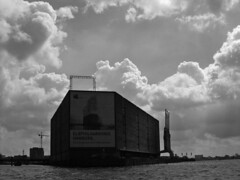
I finally understand the subject of one of my favorite photos from Germany. Herzog & De Meuron (one of my favorite architectural firms) is turning this building on the perimeter of the industrial harbour of Hamburg into a rather monolithic concert hall. A recent NY Times article describes the exciting marriages of innovative architecture and symphonies taking place today. The dreamlike ballpark interior of this hall will certainly draw me back to Hamburg to attend a performance. I just hope all these new halls incorporate really good organs. At least the organ still seems like a requisite piece of the pie, even if few composers actually use it in their concert hall pieces.
06 May 2007
art & music
Today I had the privilege of playing two short demonstration recitals on the Italian Baroque Organ at the Memorial Art Gallery. Surprisingly, the people from the smaller group seemed most interested and moved by the affair, asking specific questions afterwards about the repertoire I'd played -- Arvo Pärt's "Trivium" and even the "Cuaderno de Tonos de Maitines" of Sor María Clara. It meant so much to me that this music sparked their imaginations and curiosity. I hope I can make a career out of doing things like this more often. (Perhaps with a little more preparation.) I wasn't ready to tie the music in with the artworks I'd chosen, and I didn't have a handout... but I did the best I could, and it seemed to be just fine.

30 April 2007
conflict
So I was one of eight students nominated for consideration for an expenses-paid trip to "Convening Student Perspectives and Creating New Models for the 21st Century" at the Shepherd School of Music in October. And of course the conference coincides directly with the EROI Festival. At least I know there's no shortage of things to do next year. Ha. Ha.
In a way, I'm relieved to be forced to decline the nomination. Accepting it would make me feel sleazy. I've been frustrated at the lack of democratic processes here concerning opportunities like this. Many important things seem to happen by nomination rather than by request for interest and applications. I suppose this streamlines the process for the school and avoids situations in which nobody applies. However, it also perpetuates the current lack of interest in applying for or even thinking about participating in important non-performance activities. A vicious cycle.
For heaven's sake, I need to stop griping about my school and just accept that I have better things to do than worry about it or dream up ways in which it could be better. There are many other problems in the world that need improvement more severely than the atmosphere here.
In a way, I'm relieved to be forced to decline the nomination. Accepting it would make me feel sleazy. I've been frustrated at the lack of democratic processes here concerning opportunities like this. Many important things seem to happen by nomination rather than by request for interest and applications. I suppose this streamlines the process for the school and avoids situations in which nobody applies. However, it also perpetuates the current lack of interest in applying for or even thinking about participating in important non-performance activities. A vicious cycle.
For heaven's sake, I need to stop griping about my school and just accept that I have better things to do than worry about it or dream up ways in which it could be better. There are many other problems in the world that need improvement more severely than the atmosphere here.
23 April 2007
The weather changes every twenty minutes, going from thunderclaps and high winds to peace and sunlight before one has a chance to note the difference. Much like the changing facets of the shimmering gem I envisioned Franck's Prelude, Fugue et Variation to be in order to visualize its constantly morphing shades of mood, flitting from momentary hope to darkening disappointment but restless, never settling.
Subscribe to:
Posts (Atom)