Here they are, my submitted Fulbright essays. All this work had better get me somewhere (literally) this time:
In 2006, the sun flooded an overcast February day as I began to ring the bells of the University of Rochester’s carillon. Students emerging from classes gathered before the belfry, asking questions. Is there a musical instrument in that usually silent tower? Can students learn to play?
I enrolled at the Eastman School of Music filled with the hope that as an organ student, I could also realize the potential of this magnificent forgotten instrument, comprising four octaves of bells in a tower played without electric assistance from a keyboard and pedalboard. Over the past year, I have drawn the interest of community groups and the university president alike to this Dutch-crafted treasure, achieving my most urgent public awareness and repair goals and initiating long-term development. The Eastman Organ Department, Eastman Computer Music Center, College Music Department, and a new carillon scholar are cooperating with me in this rejuvenation. I will ensure that the movement becomes self-sustained, because my next degree will prepare me to spearhead the development of a university carillon program from which I can, as an influential teacher, set in motion the revitalization of instruments well beyond Rochester.
My twofold goal combines the organ and carillon in an unprecedented program of study. The American carillon is in jeopardy because instruments outnumber competent players. Historic instruments have fallen silent, their potential to enrich public life forgotten. My answer to this crisis is to attract new talent as a teacher and to call on organists to become stewards and even players of carillons in their churches. I am already bridging the historically related instruments through my research and professional activities. Through university teaching and research, I will establish the carillon as an academic and artistic discipline and create the first environment in which an international panoply of styles can flourish. In the Netherlands, Utrecht University is expanding the music program of its English-language international honors college, the Roosevelt Academy (RA), into the graduate Roosevelt School of Music (RSM). This offers the first chance in history for a carillonist to help realize both goals in preparation to implement them in the US.
At RSM I will study performance on both instruments and, in preparation for a teaching career, develop methods of integrating the studies with experts in both fields. My thesis for the one-year Master of Arts in Musicology & Applied Performance (Carillon) degree will build on the two years of research I will have already pursued through the interdisciplinary sequence “The History of the Organ, its Literature, and Social Context” at Eastman. I will graduate prepared to integrate the study of these instruments in doctoral studies as very few musicians or scholars can.
I am expanding the campanological collection of Eastman’s library and teaching carillon students. But in my research on parallels in the developments of the Dutch organ and carillon in terms of construction, repertoire, and social function, I have found American libraries lacking. One of my papers proposed that while organs and bells developed separately for secular use, the invention of the carillon in the early 16th century allowed their evolutions to partially converge, and during the Reformation to temporarily exchange societal roles. Furthermore, I have found that the carillon underwent equivalent developments to the organ but at intriguingly later dates. My most recent paper analyzed the growing carillon repertoire derived from organ and harpsichord music in the 17th and 18th centuries and causality in the eventual decline of carillon performance and of both carillon and organ building. At RSM, I will be able to make detailed studies of source materials such as early keyboards and carillon, organ, and harpsichord manuscripts, read the large body of carillon research centered in the Low Countries, and consult leading scholars. My thesis will probe connections beginning with the early development of the instruments, and those findings can help bring the carillon back to the forefront of organ studies.
The broader future of the carillon in America is of great concern to me. Much of our carillon heritage is in disrepair or forgotten, in part because the carillon and organ worlds have drifted apart. Carillons were first built and played largely by organ builders and organists in the Low Countries, but today organists are often given authority over carillons about which they know little. By reestablishing the carillon’s importance to organ history, I am providing knowledge that organists need to protect neglected carillons from destructive modification.
Upon attending a 2005 performance by Geert D’hollander, who would become my teacher at the Royal Carillon School, I understood for the first time what it meant not just to play the carillon, but to make music with it. His artistry rivals that of touring concert pianists. The lack of such performers in the US prevents the carillon from being taken seriously. His instruction can help me achieve a professional performance level in order to attract outstanding musicians to my program. I hope to teach a new generation to win the instrument the place it deserves in our country’s public life, revive silent carillons, and see that carillons rather than synthesized chimes are built. It is organists who can best ensure the conservation of this heritage from the Low Countries; they often fail because they are unaware of the carillon’s expressive capabilities, though it offers the largest dynamic range of any acoustic instrument. An electric chime machine and a carillon seem equally musically viable to the uninitiated—and that misconception is at the root of the disasters I want to avert. The Eastman organ department has set a precedent with its model of integrated teaching of the organ, clavichord, and pedal piano, and my curricular investigations at RSM will help me develop a similar program. Through artistry in performing, public outreach, and education, I hope to recover the carillon and to enlist defenders nationwide to recoup the tradition. I am already forging connections with organ builders and restorers. During the 2007 Eastman Rochester Organ Initiative Festival, I gave a recital and talk on the need for carillon preservation. Many of America’s prominent organ builders and scholars embraced my message and its immediate relevance to organists, urging me to bring it to yet wider audiences.
The future of the carillon also depends on international collaboration. I joined a diverse class at the RA’s past two summer carillon courses, first as a student and then as an Eastman Arts Leadership Program intern. In addition to teaching lessons, I helped adult students lay foundations for cross-cultural partnerships in education and carillon restoration between three continents. D’hollander, widely considered one of the world’s leading carillon composers and performers, acts not only as RSM carillon professor, but also as a guest teacher and liaison between national schools. I intend to continue his mission, exploring each style in my teaching to foster well-rounded musicians able to initiate change by bringing disparate communities together.
I want to participate directly in the founding year of RSM’s carillon and organ program, working with director Albert Clement, my trusted advisor and former internship supervisor, to give direction to the program and gain insight not only into educational planning, but also into the administrative challenges of establishing a graduate school. By weaving together carillon and organ training towards a doctorate, I can best meet the challenges of my career—developing an teaching practice that explores the carillon and organ as related musical instruments and that establishes a new level of carillon artistry and scholarship in the US. I want to create an interdisciplinary environment for research into historical relationships and their consequences for construction and performance practice today. The chance to prepare through direct involvement for such a goal will certainly not come again before I begin my task. Thus, there is no better time or place for me than the Roosevelt School of Music from September 2008 to May 2009.
Showing posts with label school. Show all posts
Showing posts with label school. Show all posts
18 October 2007

Personal statement
This is my "CV" or personal statement, intended to give background about me as an individual. I was unhappy with it nearly until I submitted it, but after drastic revision it's doing okay:
During my first months in Belgium as a Fellow of the Belgian American Educational Foundation in 2005, I discovered a principle governing my new life: All that can go wrong may well go wrong on the same day. But through a lens of frustrated tears, I focused on a new under-standing of life: Even the worst situations may conceal reasons to be thankful. My adjustment woes were proof that I was realizing my dream of studying the carillon. I have since met chal-lenges and setbacks with gratitude, approaching them as the complement of real progress.
That I came to music at a late age and found my calling in it even later has positively shaped my goals. I grew up more used to distant gunfire in my low-income neighborhood than the strains of art music. The piano I wanted since age four was beyond reach until my family’s hard work bought one when I was ten. Eventually I made it to Yale, where the premise that stu-dents can dive into new fields and take leadership roles brought me to two new instruments, the carillon and organ. Spearheading the carillon’s restoration and the 2006 Congress of the Guild of Carillonneurs in North America, I found power to effect change through music leadership.
Yale broadened my development in other ways. Joseph Soares’s powerful sociology course, “Public Culture in America,” gave me a new perspective on my past and a sense of my responsibility to promote equality of educational opportunity. My Yale and conservatory educa-tions have placed within my reach a wealth of possibilities from which my childhood peers re-main isolated. The love of teaching I developed over three years of teaching carillon to Yale classmates and over a summer of teaching underprivileged middle-schoolers will drive my ef-forts to level the playing field through a university career bound to public outreach. In Belgium, I took my first steps by authoring the underfunded Mechelen Carillon Museum’s first multimedia catalog to rekindle community interest and create an accessible and dynamic visitor experience. Moreover, no instrument enriches the public sphere like the carillon. In Rochester, I am drawing new audiences with innovative programming by commissioning electroacoustic composers at Eastman and local poets to create multidisciplinary performances. These events place the carillon in the vanguard of public culture and reveal its potential to enrich the arts in the community.
A mostly self-taught carillonist, I finally trained in Mechelen and earned what is normally a six-year performance certificate in one year, despite a severe bicycle accident that left me bed-ridden for five weeks but all the more grateful for the time I had remaining to achieve my goals. Although on par with some of the best American carillonists, I know I have the potential to offer students more after further training in Europe, where standards are far higher. Giving lessons at the 2007 Roosevelt Academy Summer School and now at the University of Rochester, I have found tremendous inspiration teaching students of all ages, levels, and degrees of talent. As the university’s carillon instructor, I am building on Yale’s student-centered model, delegating im-portant performances and projects to students so they experience the carillonist’s responsibility to the public. In Middelburg, I can improve my teaching and strengthen the school’s community ties by giving free music lessons and serving as a community English writing consultant.
The organ and carillon make music for all, and learning to play should be within any-one’s reach. This is the challenge I want to meet with community programs and creative concerts that draw young audiences. By organizing an annual subsidized carillon course like Pipe Organ Encounters, a program that introduces young people to the organ, I can bring music into the lives of youths who might otherwise follow the long path I have. The carillon and organ stand in churches and universities, in memorials and city halls. Like me, many learners and listeners will not reach them until they are welcomed and encouraged to pass the great institutional doors.
During my first months in Belgium as a Fellow of the Belgian American Educational Foundation in 2005, I discovered a principle governing my new life: All that can go wrong may well go wrong on the same day. But through a lens of frustrated tears, I focused on a new under-standing of life: Even the worst situations may conceal reasons to be thankful. My adjustment woes were proof that I was realizing my dream of studying the carillon. I have since met chal-lenges and setbacks with gratitude, approaching them as the complement of real progress.
That I came to music at a late age and found my calling in it even later has positively shaped my goals. I grew up more used to distant gunfire in my low-income neighborhood than the strains of art music. The piano I wanted since age four was beyond reach until my family’s hard work bought one when I was ten. Eventually I made it to Yale, where the premise that stu-dents can dive into new fields and take leadership roles brought me to two new instruments, the carillon and organ. Spearheading the carillon’s restoration and the 2006 Congress of the Guild of Carillonneurs in North America, I found power to effect change through music leadership.
Yale broadened my development in other ways. Joseph Soares’s powerful sociology course, “Public Culture in America,” gave me a new perspective on my past and a sense of my responsibility to promote equality of educational opportunity. My Yale and conservatory educa-tions have placed within my reach a wealth of possibilities from which my childhood peers re-main isolated. The love of teaching I developed over three years of teaching carillon to Yale classmates and over a summer of teaching underprivileged middle-schoolers will drive my ef-forts to level the playing field through a university career bound to public outreach. In Belgium, I took my first steps by authoring the underfunded Mechelen Carillon Museum’s first multimedia catalog to rekindle community interest and create an accessible and dynamic visitor experience. Moreover, no instrument enriches the public sphere like the carillon. In Rochester, I am drawing new audiences with innovative programming by commissioning electroacoustic composers at Eastman and local poets to create multidisciplinary performances. These events place the carillon in the vanguard of public culture and reveal its potential to enrich the arts in the community.
A mostly self-taught carillonist, I finally trained in Mechelen and earned what is normally a six-year performance certificate in one year, despite a severe bicycle accident that left me bed-ridden for five weeks but all the more grateful for the time I had remaining to achieve my goals. Although on par with some of the best American carillonists, I know I have the potential to offer students more after further training in Europe, where standards are far higher. Giving lessons at the 2007 Roosevelt Academy Summer School and now at the University of Rochester, I have found tremendous inspiration teaching students of all ages, levels, and degrees of talent. As the university’s carillon instructor, I am building on Yale’s student-centered model, delegating im-portant performances and projects to students so they experience the carillonist’s responsibility to the public. In Middelburg, I can improve my teaching and strengthen the school’s community ties by giving free music lessons and serving as a community English writing consultant.
The organ and carillon make music for all, and learning to play should be within any-one’s reach. This is the challenge I want to meet with community programs and creative concerts that draw young audiences. By organizing an annual subsidized carillon course like Pipe Organ Encounters, a program that introduces young people to the organ, I can bring music into the lives of youths who might otherwise follow the long path I have. The carillon and organ stand in churches and universities, in memorials and city halls. Like me, many learners and listeners will not reach them until they are welcomed and encouraged to pass the great institutional doors.
01 April 2007
vexation
Just to reiterate some of my frustration with Eastman, already deeply exacerbated last night vicariously and directly, would anyone care to explain why the 72 bus runs on Sundays from late morning to early afternoon and then just stops? Since it was raining, I took the bus to the River Campus to demonstrate the carillon at the request of the college urbex group. I missed the next bus out, so I figured I'd take the following one--only to find that it was in four hours. So I had to call a cab. To get from one part of my own school to another.
I knew I should have biked. It was raining lightly, but knowing Rochesterian weather, the rain would have gotten heavier the moment I started pedaling -- yes, as a direct consequence of my getting on a bike. The larger point is: Who would think to check the bus schedule for four hour gaps? From what kind of public transportation malaise does my country suffer? I suppose there is truth to the opinion, expressed by Americans and Norwegians(!) alike, that Rochester is rather similar to midwestern towns. It's undeniably a car culture; you can't reach more than a few things by going to any one place unless you're going to a mall. Have people here ever envisioned lives not attached to their cars?
For a note of levity, Mark sent me a great link to architectural comedy. This scornful and droll observer seems to share my distaste for contemporary Dutch architects, some of whom even have delusions of being Le Corbusier.
I knew I should have biked. It was raining lightly, but knowing Rochesterian weather, the rain would have gotten heavier the moment I started pedaling -- yes, as a direct consequence of my getting on a bike. The larger point is: Who would think to check the bus schedule for four hour gaps? From what kind of public transportation malaise does my country suffer? I suppose there is truth to the opinion, expressed by Americans and Norwegians(!) alike, that Rochester is rather similar to midwestern towns. It's undeniably a car culture; you can't reach more than a few things by going to any one place unless you're going to a mall. Have people here ever envisioned lives not attached to their cars?
For a note of levity, Mark sent me a great link to architectural comedy. This scornful and droll observer seems to share my distaste for contemporary Dutch architects, some of whom even have delusions of being Le Corbusier.
15 March 2007
the esm organ dept. has a website!
 Yaaaaaaaaay Eastman's Department of Organ and Historical Keyboards finally has a homepage that isn't embarrassingly out of date--design-wise. Content will get updated as time goes by, but for now... at least the content looks as if it might be current. ;) It wasn't as huge a headache as I'd been dreading.
And now it's time to make the great escape!
25 January 2007
gasp for air
 I will return to blogging. I swear. I just... need time to adjust to this semester's schedule. In the meantime, a photo I took over break.
And thank you for the item off my wish list. Unexpected but greatly appreciated. A good choice amongst many, and one that ultimately ties into a larger story.
To be continued...
12 October 2006
TRIUMPH!!!
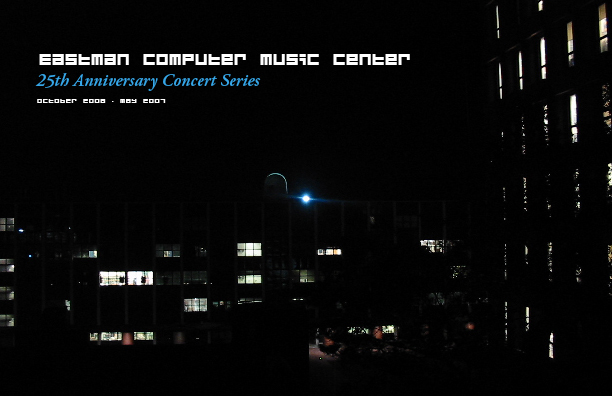 After three all-nighters, the complete program booklet of the ECMC25 anniversary concert series is available online and about to hit the presses in a few hours. This isn't the final copy as we're still waiting on some information (i.e. I have to buckle down and pick out an electroacoustic carillon concert date), but it's good enough for distribution at the concert tonight.
I finally feel like I'm back in college, i.e. being invited to eat free food with famous people. Tonight I sat across from Jean-Claude Risset, celebrated French electroacoustic music pioneer and perfectly humble and sincere gentleman. I listened to him and Allan talk about the compositional progress and compared it with the process of creative writing. We discussed the effects of intense concentration and focus vs. multitasking and their consequences for creative inspiration. Afterwards I showed ECMC International Electroacoustic Competition winner Juraj Kojs (originally from Slovakia) around the school and library - special collections was somehow open late and the Mozart autograph of one of his symphonies was out - score! ummm... pun not intended), and he took me out to dessert although we're both broke students and although I had only negative free time to spare. But these kinds of things are important. It's not just the work you do cooped up in your room that might turn out to be good for you.
More famous people are converging on campus through the EROI Festival 2006 (which just had to kick off at the same time as the ECMC25 Series) and hopefully we'll get free dinner with them for our efforts (we deserve at least that much, considering that our names were left out of the program booklet so nobody will be able to look us up afterwards). And I'll get more free banquetage from volunteering for Eastman Weekend. Who knows what personnages might show up for that.
EROI and the ECMC are throwing opportunities at us to appear on TV by getting filmed a$$-early. And I could just stay up a little longer and head over. But I might just take this opportunity to sleep a wink, since I've definitely done magnitudes more working on this booklet in the past few days than sleeping, and the Skinner-Brombaugh video for Friday broadcast is only 1/3 done.
Subscribe to:
Posts (Atom)